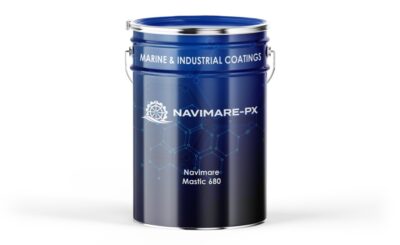
FEATURES
- Tin free — contains high levels of cuprous oxide and acrylates
- Unique self-polishing mechanism prevents attachment of fouling organisms
- Smoothing action helps reducing drag resistance
- Fully compatible with most anticorrosive coatings
RECOMMENDED USES
Navimar is used on coated steel hulls of seagoing vessels, workboats and barges. Navimar is used where long-life fouling protection in severe service is required. Navimar is recommended where regulations ban or restrict the use of organotin compounds and also where maximum compatibility with a wide range of bottom systems or other special surfaces is required.
SPECIFICATION DATA
| Coating Type |
: Tin Free Self Polishing |
| Color |
: 287-S-5772 Red; 287-S-5773 Black |
| Density (at 20°C) |
: 1.80±0.25 Kg/Lt. |
| Viscosity (at 20°C) |
: 15–25 P (Brookfield spindle No.3, RPM:20) |
| Packaging |
: Single Component. |
| Gloss |
: Glossy |
| Recommended Film Thickness |
: 185–278 mic WFT to obtain 100–150 mic DFT. |
| Flash Point |
: 27°C Setaflash mixed |
| Thinner |
: Thinning not recommended. Clean up with T-10 Thinner. |
| Shelf life |
: More than 2 years when stored indoors in unopened original containers at 5–40°C. |
| Temp. resistance |
: 121°C Dry. |
| VOC |
: 399 gr/Lt. |
| Volume Solid |
: 50% ±4 ASTM D2697 (7 Days) |
| Theoretical spreading rate |
: 3.40 m²/Lt/150 mic. DFT 273 mic. WFT. Allow for application losses. |
| Application |
: Air spray, Airless spray, brush |
| Drying time |
: 20°C, 50% RH, 50 mic. DFT. Dry to self-recoat: min 5 hours. Immersion service: min 6 hours. |
Surface Preparation
Coating performance is proportional to the degree of surface preparation. Refer to the anticorrosive coating being applied. Depending on the condition of hull and existing antifouling, surface cleaning will vary from high pressure fresh water cleaning to abrasive blasting. After immersion service, high pressure fresh water wash is required prior to top coating with additional Navimar. Apply over suitable primer system or clean, intact, existing bottom system. Steel — Prepare surface in accordance with instructions for anticorrosive coating to be used. Non-fouled surfaces: high pressure fresh water wash. Existing fouled surfaces: remove fouling by scraping and/or sanding. Loose paint should be removed by high-pressure fresh water wash. Tightly adhering anticorrosive and antifouling coating may remain.
Priming, Mixing, Thinning
Stir well before application. Do not thin. Film thickness control is critical to the performance of this coating. NOTE: If applying Navimar antifouling over epoxy or coal-tar epoxy anticorrosive coatings, apply the first coat of antifouling while the anticorrosive is still tacky or soft to fingernail. At temperatures above 10°C, the topcoating time will be between 5 and 10 hours. Failure to apply antifouling while the anticorrosive epoxy is still tacky may result in poor adhesion and delamination.
Application
Airless Spray: Standard airless spray equipment such as Graco Bulldog Hydra-Spray or larger with a 0.53 to 0.63 mm (0.021–0.025 inch) fluid tip.
Conventional Spray: Industrial equipment such as De Vilbiss MBC or JGA spray gun. Separate regulators for air and fluid pressure, mechanical pot agitator and a moisture and oil trap in the main air supply line are recommended.
Application Procedure: (1) Clean all application equipment with T-10 Thinner. (2) Stir material thoroughly and continue stirring during application. (3) Thinning is not recommended. (4) Apply a wet coat in even, parallel passes; overlap each pass 50%. Give special attention to weld seams and rough areas. If required, cross-spray at right angles. (5) For touch-up, apply additional material after removing dirt and loose coatings. (6) Allow 4–5 hours drying at 20°C before applying second coat. (7) Before immersing, allow Navimar to dry at least 6 hours at 20°C. (8) Clean application equipment immediately after use with T-10 Thinner.
Precaution
Refer to material safety data sheet of the product. Additional safety information is available upon request. Minimum safety precautions in dealing with the paints are;
- Avoid skin and eye contact by wearing overalls, gloves, goggles, mask, etc.
- Spillage on the skin should immediately be removed by thorough washing with lukewarm water and soap or a suitable industrial cleaner.
- Eyes should be flushed with fresh water and medical attention sought immediately.
- Spraying should be carried out under well-ventilated conditions. Avoid inhalation of solvent vapours and paint mist by wearing an air mask.
- This product contains flammable materials and should be kept away from sparks and open flames. Smoking in the area should not be permitted.
Disclaimer
This is not a specification and all information is given in good faith. Since conditions of use are beyond the manufacturer’s control, information contained herein is without warranty, implied or otherwise, and final determination of the suitability of any information or material for the use contemplated, the manner of use and whether there is any infringement of patents is the sole responsibility of the user. Manufacturer does not assume any liability in connection with the use of the product relative to coverage, performance or injury. For application in special conditions, consult Navimare-PX for detailed recommendations.